A Chinese wedding banquet usually runs about four hours: guest arrival and red envelopes, the couple’s grand entrance, welcome speeches and a first toast, then eight or so courses with the program fitted between them, an outfit change and second entrance, a group toast, table visits, and a send-off at the door. Here is how a bilingual MC puts it on the clock.
Key takeaways
- Program moments sit between courses, so the MC and the banquet captain share one timeline.
- Eight courses is common; banquets range from about five to ten, and some regional menus go to twelve.
- The group toast is “yam seng” in Cantonese; in Mandarin the MC usually leads “gānbēi” (干杯).
- The couple and often their parents visit every table to toast and thank guests.
- Chinese banquets often start later than the invitation says, so build a buffer into the first hour.
- The night ends with the couple and parents seeing guests off at the door.
What is the order of events at a Chinese wedding banquet?
The usual order is arrival, grand entrance, speeches and first toast, dinner courses with program moments in between, second entrance, group toast, table visits, and send-off. Families and venues change the details, but most banquets follow this shape, as the National Heritage Board of Singapore’s entry on Chinese weddings also describes.
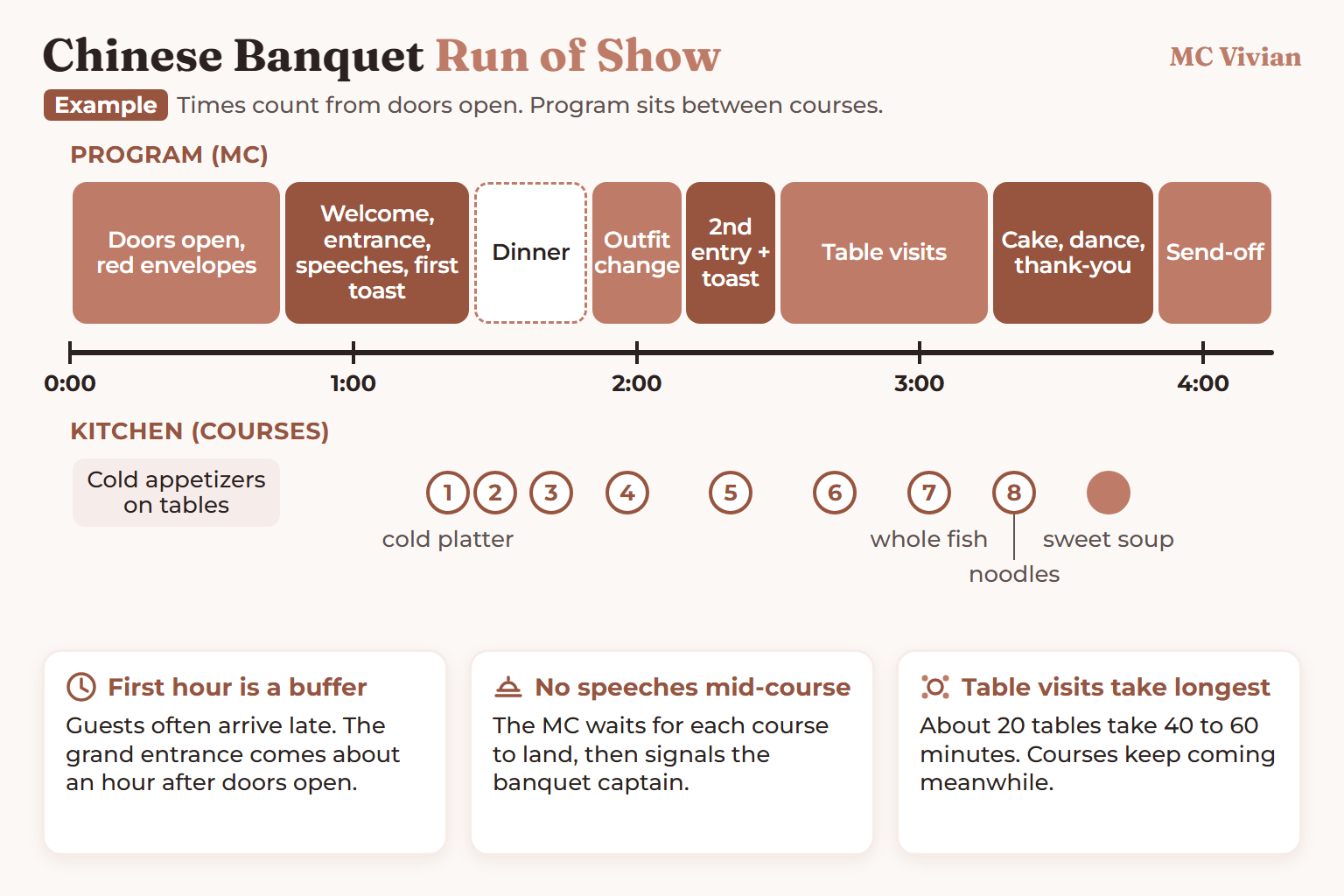
Below is an example run of show for a 7:00 pm start with about 200 guests. Times count from doors open, so you can slide them to your own start time.
| Time | Program (MC) | Kitchen / courses |
|---|---|---|
| 0:00 | Doors open. Guests sign the guest book and hand red envelopes to the reception table. Background music; slideshow or pre-wedding photo album on display. | Drinks, cold appetizers on tables |
| 0:45 | MC welcome in both languages; asks guests to take their seats; introduces parents and VIP table | – |
| 1:00 | Grand entrance. MC asks everyone to stand; couple enters to their song and walks to the head table | – |
| 1:10 | Welcome speeches (parents, then a short thank-you from the couple); first toast | Course 1: cold platter served right after the toast |
| 1:25 | Dinner music; short break for guests to eat | Courses 2 and 3 |
| 1:50 | Couple leaves for outfit change; MC fills with a photo slideshow, a short game or a story about the couple | Course 4 |
| 2:10 | Second entrance in the new outfit | Course 5 |
| 2:20 | Group toast: the couple, parents and wedding party on stage; MC leads three “yam seng” or “gānbēi” cheers | – |
| 2:30 | Table visits: couple (often with parents) toasts every table; photos at each table | Courses 6 and 7, including the whole fish |
| 3:15 | Cake cutting, first dance or games (optional) | Course 8: noodles or fried rice |
| 3:35 | Couple’s thank-you; final words from the MC | Dessert (sweet soup) |
| 3:50 | Send-off: couple and parents stand at the door to thank each guest | – |
Why does the run of show follow the courses?
Because the kitchen controls the clock. A banquet hall plates hundreds of dishes per course, and a long speech in the middle of a course means cold food. The MC agrees in advance with the banquet captain which moments happen between which courses, then signals the kitchen when each moment is done.
Common courses and what they mean (menus vary by family and region; see Paperlust’s Chinese wedding traditions guide and Easy Weddings):
- Whole steamed fish: the word for fish sounds like “abundance” or “surplus”, so it is served whole.
- Lobster or prawns: happiness and liveliness.
- Roast suckling pig or whole duck or chicken: completeness; the bird is linked to the phoenix.
- Noodles: long life, usually served late in the meal.
- Sweet soup or dessert: a sweet life together.
The number four is usually avoided in course counts because it sounds like the word for death.
What happens at the grand entrance and speeches?
The MC asks guests to stand just before the couple enters and invites them to sit once the couple reaches the head table. Speeches usually come next: parents first, then the couple. Keep each speech short (two or three minutes) and ask non-native speakers if they want the MC to give a one-line summary in the other language, rather than a full translation, so the room stays with them.
What is the yam seng toast, and what do you say in Mandarin?
Yam seng (饮胜) is a Cantonese group toast. The MC invites the couple and their family on stage, and the whole hall shouts “yam seng” three times, each one longer and louder, to bless the marriage. It is very common in Cantonese and Southeast Asian Chinese weddings, as SAYS’ guide for wedding guests explains.
At Mandarin-speaking weddings the MC usually leads “gānbēi” (干杯, “cheers”, literally “dry the cup”) instead, or a mix of both if the families speak both. Non-drinkers can toast with tea or juice.
How do table visits and red envelopes work?
Table visits: after the group toast, the couple (often with their parents) visits every table to raise a glass and thank guests. Guests stand, toast and take a photo with the couple. For 20 tables, plan 40 to 60 minutes, and give the photographer a table map.
Red envelopes: guests usually hand their red envelope (hongbao, also called ang pow or lai see) at the reception table on arrival, where a trusted family member or friend records names and keeps the box safe. The couple does not usually collect envelopes during dinner. In mainland China, too, guests bring red envelopes on entry, according to the Chinese Language Institute. The couple may also give red envelopes to helpers and venue staff.
How should the night end?
The couple, usually with both sets of parents, stands at the exit and thanks each guest as they leave. Guests are generally expected to stay until the end of dinner, so the MC announces the send-off clearly. Couples often hand out favors or sweets here and take quick photos.
What does a bilingual MC say at each moment?
In a mixed room, the MC says each cue in Mandarin and English, with the English short enough that nobody waits.
Bilingual MC phrases for the banquet
| Moment | Mandarin | Pinyin | English |
|---|---|---|---|
| Welcome | 各位来宾,晚上好! | Gèwèi láibīn, wǎnshang hǎo! | Good evening, everyone! |
| Ask to sit | 请各位来宾入座。 | Qǐng gèwèi láibīn rùzuò. | Please take your seats. |
| Ask to stand | 请全体起立。 | Qǐng quántǐ qǐlì. | Please rise. |
| Grand entrance | 让我们以热烈的掌声欢迎新郎新娘入场! | Ràng wǒmen yǐ rèliè de zhǎngshēng huānyíng xīnláng xīnniáng rùchǎng! | Please give a warm welcome to the bride and groom! |
| Parents’ speech | 有请双方父母致辞。 | Yǒu qǐng shuāngfāng fùmǔ zhìcí. | We now invite both sets of parents to say a few words. |
| Group toast | 让我们一起举杯:干杯! | Ràng wǒmen yìqǐ jǔ bēi: gānbēi! | Let’s all raise our glasses: cheers! |
| Table visits | 新人将到各桌敬酒,感谢大家。 | Xīnrén jiāng dào gè zhuō jìng jiǔ, gǎnxiè dàjiā. | The couple will now visit each table to toast and thank you. |
| Blessing | 祝新人白头偕老,永结同心! | Zhù xīnrén báitóu xiélǎo, yǒng jié tóngxīn! | May the couple grow old together, united forever! |
| Send-off | 感谢各位光临,请慢走。 | Gǎnxiè gèwèi guānglín, qǐng màn zǒu. | Thank you for coming. Please travel home safely. |
How do you keep a Chinese banquet on time?
- Build a buffer. Banquets often start later than the stated time; plan the grand entrance for about an hour after doors open.
- One run sheet, three copies. MC, banquet captain and DJ hold the same sheet with course numbers next to each moment.
- Cap the speeches. Two or three minutes each, and no more than three or four speakers.
- Time the outfit change. Agree how many minutes it takes and what the MC does while you are gone.
- Map the tables. The table-visit order (head table outward, or by family) should be written down in advance.
For general wedding-day timing outside the banquet, see Creating the Perfect Wedding Day Timeline. For game ideas to fill the outfit change, see Top 9 Wedding Games for a Memorable Reception.
Who runs the banquet on the day?
I’m Vivian, a bilingual wedding MC. I host in English, Mandarin Chinese, or both, so announcements, introductions and toasts are understood by every guest.
I’m also an ordained officiant for weddings in New York and New Jersey, so I can officiate your ceremony, guide your tea ceremony and host your reception, all in one day. I serve New York City, North New Jersey and Long Island, with over 10 years of experience in the wedding industry.
Before your banquet, I build the run sheet with you, your venue and your banquet captain, so every speech, toast and course has its place and your guests never wait in silence.
Wondering whether you need a professional MC at all? Read Why You Need an Emcee for Your Chinese or Bilingual Wedding.
Frequently asked questions about the banquet timeline
How long is a Chinese wedding banquet?
Most Chinese wedding banquets run about three and a half to four hours from doors open to send-off. Dinner itself, with eight or so courses and the program in between, usually takes more than two hours.
How many courses are served at a Chinese wedding banquet?
Eight courses is very common, but banquets range from about five to ten courses, and some regional menus go up to twelve. Families usually avoid four because it sounds like the word for death.
When do guests give red envelopes at a Chinese wedding?
Guests usually hand their red envelope to the reception table when they sign in on arrival. A trusted family member or friend keeps the envelopes safe, so the couple does not collect them during dinner.
What is the difference between yam seng and gānbēi?
Yam seng is a Cantonese group toast shouted three times to bless the couple. Gānbēi is the Mandarin word for cheers. A bilingual MC can lead either, or both, depending on the families.
When does the couple visit each table?
Table visits usually follow the group toast, partway through dinner. The couple, often with their parents, toasts and thanks each table and takes a photo with the guests.
Plan your banquet with a bilingual MC
Send me your venue and guest count, and I’ll help you build a run of show that keeps the kitchen, the DJ and both families on the same page.
Talk to your Chinese wedding MC.
The timeline above is an example, not a rule. Banquet customs vary by region (Cantonese, Mandarin-speaking, Fujianese, Southeast Asian) and by family.