The traditional Chinese tea ceremony order is: the groom’s family first, then the bride’s family. Within each family, tea goes by seniority, usually parents first, then grandparents, then uncles and aunts from oldest to youngest, then older siblings. Many families swap parents and grandparents or alternate sides, so agree on the list with both families before the day.
Key takeaways
- The groom’s side is traditionally served before the bride’s side, though modern couples often alternate or start with the bride’s family.
- Inside each family, seniority decides the order. Some families serve grandparents before parents.
- The couple usually kneels (or bows) and offers each cup with both hands, addressing the elder by their family title.
- Elders reply with a blessing and usually a red envelope or gold jewelry. Jewelry is often worn right away.
- Younger siblings and cousins are optional; traditionally they do not receive tea.
- A written serving list with each elder’s title, read by the MC, keeps the ceremony smooth and on time.
What is the traditional Chinese tea ceremony order?
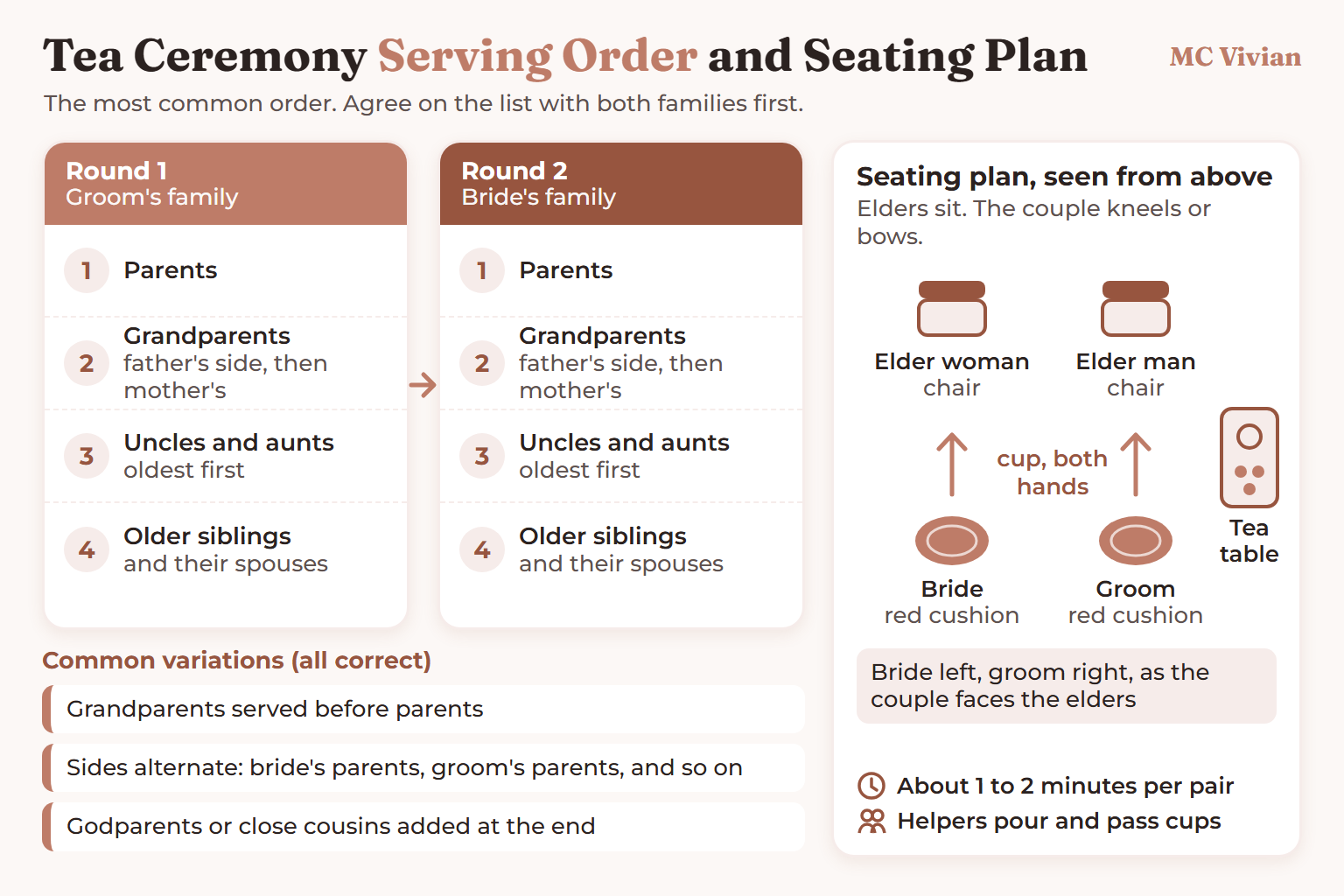
The groom’s family is traditionally served first, then the bride’s family. Within each family, elders are served by seniority. Here is the most common order, with the main variations.
Round 1: groom’s family
- Groom’s parents
- Groom’s paternal grandparents, then maternal grandparents
- Groom’s uncles and aunts, oldest first
- Groom’s older siblings (and their spouses)
Round 2: bride’s family
- Bride’s parents
- Bride’s paternal grandparents, then maternal grandparents
- Bride’s uncles and aunts, oldest first
- Bride’s older siblings (and their spouses)
Where traditions differ
- Parents or grandparents first? Some guides put parents first; others put grandparents first out of respect for the oldest generation, as Hotel ICON’s tea ceremony guide notes. Both are correct. Ask the most senior person in each family what they expect.
- Which side first? The groom-first rule comes from the custom of the bride joining the groom’s family. Many couples now alternate (bride’s parents, groom’s parents, bride’s grandparents, groom’s grandparents) or simply serve whichever family is ready, as The Woks of Life describes.
- One ceremony or two? Traditionally there were two: one at the groom’s home and one at the bride’s. In many families the bride also serves her own parents privately before the groom arrives, according to the Chinese Historical & Cultural Project. Today most NY and NJ couples hold one combined tea ceremony at the venue or a hotel suite.
- Younger relatives: Traditionally, younger siblings do not receive tea (Paperlust’s Chinese wedding traditions guide covers this). Some families include close cousins, godparents or family friends anyway.
Where does everyone sit and kneel?
The elders sit; the couple kneels or bows in front of them. A common layout:
- Two chairs face the couple. The elder man sits facing the groom, and the elder woman sits facing the bride.
- The bride is on the left and the groom on the right (as the couple faces the elders), each on a red kneeling cushion.
- A side table holds the tea set, spare cups and a tray for red envelopes and jewelry.
- Two or three helpers (often bridesmaids or a trusted aunt) pour, pass cups and keep clean cups coming.
Not every family kneels. Some couples kneel only for parents and grandparents and bow for everyone else. Older relatives with mobility needs can be served standing.
How do you serve the tea, step by step?
Each pairing takes one to two minutes:
- The MC calls the elders by title and invites them to sit.
- The couple kneels or bows.
- A helper hands a cup to the groom, who offers it with both hands to the elder facing him and says their title, for example “Ba, please have some tea.” The bride then does the same.
- The elders sip (they do not have to finish), say a blessing, and return the cup.
- The elders give red envelopes (hongbao) or gold jewelry. If they hand jewelry over directly, it is customary to put it on right away.
- The couple thanks them, stands and the next pair is called.
What goes in the tea: usually a red (black) tea or another mild tea, served warm rather than hot. Many families add red dates (sweetness and an early child), lotus seeds (many children) and dried longan (completeness). Avoid a white tea set or one with only a dragon or only a phoenix; red-and-gold sets with paired dragon and phoenix, or the double happiness character 囍, are traditional.
How long it takes: plan about 1 to 2 hours for a large family, or 30 to 45 minutes for parents and grandparents only. Build this into the day before you set the ceremony and reception times.
What does the MC say during the tea ceremony?
The MC’s job is to call each elder by the right title, explain the meaning for guests who are new to the tradition, and keep the line moving. In a bilingual room, the MC says each cue in Mandarin and then a short English version, so grandparents and colleagues follow the same moment.
Bilingual MC phrases for the tea ceremony
| Moment | Mandarin | Pinyin | English |
|---|---|---|---|
| Opening | 现在开始敬茶仪式。 | Xiànzài kāishǐ jìng chá yíshì. | The tea ceremony now begins. |
| Call the first pair | 有请男方父母入座。 | Yǒu qǐng nánfāng fùmǔ rùzuò. | Would the groom’s parents please take their seats. |
| Couple’s cue | 请新人行礼敬茶。 | Qǐng xīnrén xínglǐ jìng chá. | Bride and groom, please pay your respects and serve the tea. |
| Couple to parents | 爸爸,妈妈,请喝茶。 | Bàba, māma, qǐng hē chá. | Dad, Mom, please have some tea. |
| Couple to paternal grandparents | 爷爷,奶奶,请喝茶。 | Yéye, nǎinai, qǐng hē chá. | Grandpa, Grandma (father’s side), please have some tea. |
| Couple to maternal grandparents | 外公,外婆,请喝茶。 | Wàigōng, wàipó, qǐng hē chá. | Grandpa, Grandma (mother’s side), please have some tea. |
| Elder’s blessing | 祝你们百年好合,早生贵子。 | Zhù nǐmen bǎinián hǎohé, zǎo shēng guìzǐ. | Wishing you a hundred years of harmony, and a child soon. |
| Thank-you | 谢谢爸妈! | Xièxie bà mā! | Thank you, Mom and Dad! |
| Close | 敬茶仪式圆满结束,谢谢大家。 | Jìng chá yíshì yuánmǎn jiéshù, xièxie dàjiā. | The tea ceremony is complete. Thank you, everyone. |
Who calls whom what: a quick title list
Getting titles right matters more than speed. A few common Mandarin family titles (northern families may say 姥爷/姥姥 lǎoye/lǎolao for maternal grandparents):
| Relative | Title |
|---|---|
| Father’s older brother / his wife | 伯伯 bóbo / 伯母 bómǔ |
| Father’s younger brother / his wife | 叔叔 shūshu / 婶婶 shěnshen |
| Father’s sister | 姑姑 gūgu |
| Mother’s brother | 舅舅 jiùjiu |
| Mother’s sister | 阿姨 āyí or 姨妈 yímā |
Titles also vary by dialect and family, and many families say “First Uncle”, “Second Aunt” and so on. Write each elder’s title on the serving list in both characters and English, and have the MC check pronunciation with you beforehand.
One more thing to ask your families: in many Mandarin-speaking families the tea is also the moment the couple first calls their in-laws “Mom” and “Dad” (改口 gǎikǒu), and parents may give a red envelope for it. Customs differ by region, so ask both sets of parents whether they expect this.
How do you prepare the serving list?
Two weeks before the wedding, build one shared list:
- Elder’s name, relationship and title (characters, pinyin and English)
- Round (groom’s or bride’s side) and position in the order
- Whether they are served kneeling or with a bow, and any mobility needs
- Who is giving jewelry (so a helper is ready to help put it on)
Send it to your MC, planner and photographer. The photographer needs the order too, because every pairing is a photo your families will want.
Can one person officiate, run the tea ceremony and host the reception?
Yes. When the same person handles all three, the titles, pronunciations and timing carry through the whole day without a hand-off.
I’m Vivian, a bilingual wedding MC and ordained officiant. I host in English, Mandarin Chinese, or both, and I can officiate your ceremony, guide your tea ceremony and host your reception, all in one day.
I officiate weddings in New York and New Jersey, and I serve New York City, North New Jersey and Long Island, with over 10 years of experience in the wedding industry. See my wedding officiant page for how the legal side works.
Before the day, I go through your serving list with you so every elder is called by the right title, in the right order, and in the language they understand best.
If you are still deciding whether you need an MC at all, read Why You Need an Emcee for Your Chinese or Bilingual Wedding. For planning the rest of a two-culture day, see An Ultimate Guide to Bilingual Weddings.
Frequently asked questions about the tea ceremony order
Who do you serve first at a Chinese tea ceremony?
Traditionally the groom’s parents are served first, then the rest of the groom’s family by seniority, then the bride’s family. Some families serve grandparents before parents or alternate between the two families, so confirm the order with both sides.
Do you have to kneel at a Chinese tea ceremony?
Kneeling is the traditional and most respectful way to serve, but it is not required. Many couples kneel only for parents and grandparents and bow for other relatives, and elders with mobility needs can be served standing.
What do elders give at the tea ceremony?
After drinking the tea, elders usually give a red envelope with money, gold jewelry, or both, along with a blessing for the couple. If jewelry is handed over directly, it is customary to put it on right away.
How long does a Chinese tea ceremony take?
Allow about 30 to 45 minutes for parents and grandparents only, and 1 to 2 hours for a large extended family. Each pairing takes one to two minutes, plus photos.
Can the tea ceremony be in English and Mandarin?
Yes. A bilingual MC can call each elder by their Chinese title and explain each step in English, so relatives from both cultures follow the same moment.
Plan your tea ceremony with a bilingual MC
Send me your family list and your wedding date, and I’ll help you turn it into a calm, clear tea ceremony that honors both families.
Check availability with your Chinese wedding MC.
Tea ceremony customs vary by region, dialect and family. Where the guides we used disagree, this article says so; your own families’ wishes come first.